Signs It Might Be Time for Couples Counseling

Most couples wait too long before seeking counseling. Research published in the Journal of Marital and Family Therapy found that couples wait an average of 2.68 years from the onset of serious relationship problems before starting therapy, with many delaying even longer (Doherty et al., 2021). That delay matters: relationship patterns calcify over time, and what might have been addressed in a few sessions early on can require much more intensive work later.
The question isn't whether a relationship is "broken enough" to warrant therapy. The question is whether addressing patterns now—while goodwill and emotional reserves remain—makes more sense than waiting until resentment has hardened into something far more difficult to repair.
What Brings Most Couples to Therapy?
Communication problems consistently rank as the top presenting issue in couples therapy, but the specifics vary widely. For some couples, communication breakdown means frequent arguments that escalate quickly. For others, it's a pattern of shutting down or avoiding difficult conversations altogether—feeling like roommates who share logistics but rarely share anything deeper.
Lack of emotional closeness is another frequent concern. Couples describe noticing that conversations stay surface-level while deeper emotional sharing has become rare or nonexistent.
Interest in divorce or separation also brings many couples to counseling. Some come to see if the relationship can be repaired; others come to explore whether separation might be the healthier path or to navigate divorce in a way that minimizes harm, particularly when children are involved.
Other common issues include navigating major life transitions—becoming parents, dealing with infertility, managing chronic illness, adjusting to retirement—where the stress of change exposes underlying relationship vulnerabilities. Sexual concerns, financial conflict, infidelity, and differences in parenting approaches round out the frequent presenting problems.
The Warning Signs Research Identifies
Relationship researcher John Gottman identified four communication patterns—criticism, contempt, defensiveness, and stonewalling—that reliably predict divorce, with contempt standing out as the single greatest predictor (Gottman Institute, 2024). These patterns, known as the Four Horsemen, are among the most reliable indicators that a relationship needs professional intervention.
Criticism turns specific complaints into global attacks on a partner's character, often using words like "never" or "always." Contempt—the most corrosive of the four—involves treating a partner with disdain, mockery, or sarcasm, assuming a position of moral superiority. Defensiveness means responding to complaints with counter-complaints or righteous indignation instead of taking responsibility. Stonewalling occurs when one partner withdraws completely, shutting down and simply stopping engagement.
Even happily married couples argue—sometimes loudly. The issue is less about whether couples argue and more about whether they can repair after conflict—whether they can find their way back to connection rather than letting resentment accumulate.
When Conflict Styles Predict Problems
Research has found that conflict style mismatches are particularly problematic. When one partner wants to address issues immediately and intensely while the other withdraws or shuts down, that pattern is associated with lower relationship satisfaction and stability over time.
Research also links conflict style to relationship satisfaction: the way partners handle disagreements is associated with how satisfied they feel in the relationship (Cramer, 2000). Couples who can engage constructively with disagreements tend to fare better than those stuck in patterns of escalation or avoidance.
Pay attention if conflicts rarely resolve but simply fade without resolution, only to resurface in slightly different forms weeks or months later. Also notice if arguments feel repetitive—the same core issue cycling through with different surface details but no underlying change.
The Optimal Timing for Couples Counseling
Evidence-based couples therapy shows significant improvements in relationship satisfaction that are maintained at two-year follow-up (Wiebe et al., 2017). However, therapy is most effective when couples still have emotional reserves to draw on—when there's still affection underneath the frustration, still a desire to understand each other even when understanding feels out of reach.
Waiting until resentment has accumulated for years makes the therapeutic work harder. Patterns that have repeated for a decade are more entrenched than patterns that have been going on for six months.
Consider couples counseling when you notice:
- Persistent patterns that aren't improving on their own
- Repeating the same conflicts without resolution
- Growing emotional distance without knowing how to close that gap
- The Four Horsemen (criticism, contempt, defensiveness, stonewalling) appearing regularly in your interactions
- Mental rehearsal of arguments or keeping score of grievances
- Dread when certain topics come up
Early intervention—when problems first become noticeable and frustrating—tends to require fewer sessions and yields better outcomes.
When One Partner Is Hesitant
Couples often wait years before starting therapy (Doherty et al., 2021), and one common reason is that partners aren't always equally ready to begin.
If a partner is hesitant, it helps to understand what might be driving that resistance. Some people worry that therapy means the relationship is failing or that a therapist will assign blame. Others had negative experiences with therapy in the past or come from families where seeking outside help felt like betrayal or weakness.
Frame therapy as a tool for learning specific skills—improving how you talk through differences, rebuilding connection, navigating a particular stressor—rather than as an emergency intervention. Start the conversation during a calm moment, not in the aftermath of a fight. Express what you hope might change rather than listing grievances: "I miss feeling connected to you, and I think talking to someone together might help us find a way through this" lands differently than an itemized list of complaints.
If a partner remains unwilling, individual therapy can still help clarify your own patterns, set healthier boundaries, and decide what you need from the relationship. Sometimes, when one partner begins individual work, the other becomes more open to couples therapy later.
What Might Indicate Waiting Has Taken a Toll
Couples therapy can help at almost any stage, but certain patterns suggest waiting has made the work significantly more challenging.
If one or both partners have emotionally checked out—meaning there's pervasive indifference rather than frustration or hurt—that's a concerning sign. Active conflict, while painful, indicates that both people still care enough to fight for change. Indifference suggests one or both partners have begun grieving the relationship while still in it.
Active affairs that the involved partner has no intention of ending, ongoing substance abuse that remains unaddressed, or patterns of violence or intimidation complicate couples therapy and may require individual treatment or safety planning first.
That said, even relationships with significant damage can sometimes be repaired if both partners are willing to do the work. The key factor isn't the severity of the problems but whether both people genuinely want the relationship to improve and are willing to examine their own contributions to the patterns, not just their partner's.
Preventive Care, Not Just Crisis Intervention
Couples therapy isn't only for relationships on the brink of ending. Many couples seek support during major transitions, when adding a new skill set—like navigating blended family dynamics or learning to disagree more constructively—would strengthen an already stable foundation.
Think of couples counseling the way you might think about regular medical care. Preventive visits address small problems before they become large ones. The same principle applies to relationships.
If you're asking yourself whether your problems are serious enough for therapy, that question itself suggests you're noticing patterns that concern you. Trust that concern. Therapy can help address patterns early, before they grow into something more entrenched and painful.
Starting Couples Counseling in Alpharetta, GA
If you're recognizing patterns in your relationship that you'd like to address, reaching out for support is a practical step forward. Investing in your relationship doesn't mean it's broken—it means you're choosing to strengthen it before patterns calcify further.
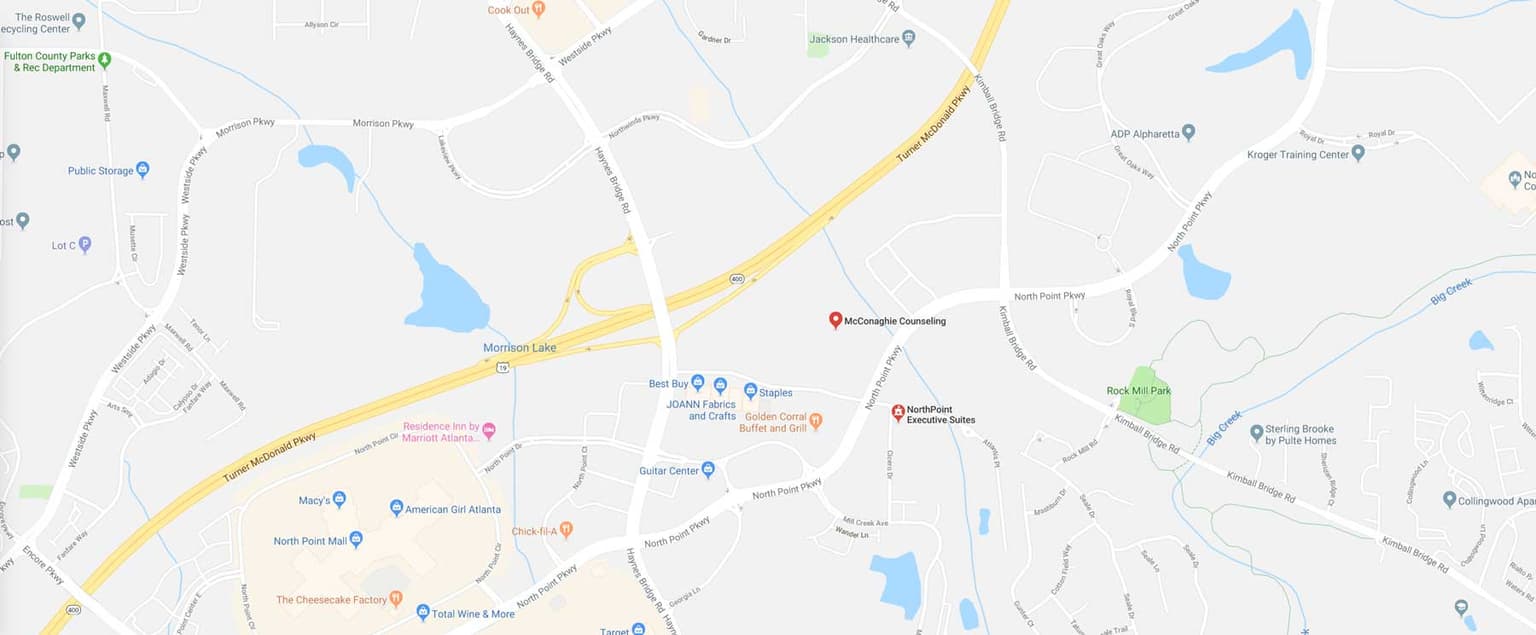
McConaghie Counseling offers in-person couples counseling in Alpharetta, GA and telehealth throughout Georgia. Our therapists use evidence-based approaches—including Emotionally Focused Therapy and the Gottman Method—to help couples improve communication, rebuild connection, and navigate difficult transitions. Practice founders Andrew McConaghie, LCSW, and Tracy McConaghie, LCSW, RPT/S, lead a team that specializes in couples work and has helped hundreds of couples find their way back to each other.
To schedule a consultation, visit mcconaghiecounseling.com/contact or call our office directly.
References
Cramer, D. (2000). Relationship satisfaction and conflict style in romantic relationships. The Journal of Psychology, 134(3), 337–341. https://pubmed.ncbi.nlm.nih.gov/10907711/
Doherty, W. J., Harris, S. M., Hall, E. L., & Hubbard, A. K. (2021). How long do people wait before seeking couples therapy? A research note. Journal of Marital and Family Therapy, 47(4), 882–890. https://pubmed.ncbi.nlm.nih.gov/33411353/
Gottman Institute. (2024). The Four Horsemen: Criticism, contempt, defensiveness, and stonewalling. https://www.gottman.com/blog/the-four-horsemen-recognizing-criticism-contempt-defensiveness-and-stonewalling/
Wiebe, S. A., Johnson, S. M., Lafontaine, M.-F., Burgess Moser, M., Dalgleish, T. L., & Tasca, G. A. (2017). Two-year follow-up outcomes in emotionally focused couple therapy: An investigation of relationship satisfaction and attachment trajectories. Journal of Marital and Family Therapy, 43(2), 227–244. https://pubmed.ncbi.nlm.nih.gov/27997704/