Understanding OCD in Children: When Intrusive Thoughts Aren't Just Worries
When is a child's worry about germs just normal caution, and when does it cross into obsessive-compulsive disorder? Childhood OCD causes intrusive, persistent thoughts that a child can't control, paired with repetitive behaviors they feel compelled to perform to reduce distress. Unlike typical childhood worries that come and go, OCD thoughts return constantly, causing genuine suffering and interfering with school, friendships, and family life. The key difference: normal worries respond to reassurance and fade over time, while OCD thoughts demand repeated rituals that only provide temporary relief before the cycle starts again.
OCD affects between 1% and 3% of children and adolescents. Boys are more likely than girls to develop OCD before puberty, though rates even out during adolescence. Many children develop OCD symptoms during elementary and middle school years, making early recognition important—children who receive appropriate treatment learn to manage intrusive thoughts without letting compulsions control their daily lives.
What Does OCD Look Like in Children?
Obsessive-compulsive disorder in children involves two distinct components: obsessions (intrusive, unwanted thoughts that cause distress) and compulsions (repetitive behaviors or mental acts the child performs to neutralize the distress). The child doesn't enjoy these rituals—they feel driven to perform them to prevent something bad from happening or to make an uncomfortable feeling go away.
Common obsessions in children include fears of contamination from germs or dirt, worries about accidentally hurting a family member, fears that a parent will die or leave, concerns about symmetry or things being "just right," and intrusive thoughts about violence or forbidden behaviors that feel deeply disturbing to the child.
Compulsions—the behaviors children use to cope with obsessions—might be visible (washing hands until they're raw, checking locks repeatedly, arranging objects in precise order, touching things a certain number of times) or invisible to parents (counting silently to a specific number, repeating phrases in their head, mentally reviewing events to ensure nothing bad happened, making internal "deals" about what must happen to keep loved ones safe).
One key distinction: these aren't choices. A child with OCD doesn't wash their hands 20 times because they enjoy it or to get attention. They wash because the distress of not washing feels unbearable, and the ritual provides temporary relief before the obsessive thought returns.
How Is This Different from Normal Childhood Anxiety?
Many children go through phases of increased worry—checking under the bed for monsters, asking repeated questions about safety, or developing brief preferences for routine. These normal developmental anxieties typically respond to reassurance, don't significantly impair daily functioning, and fade as the child matures.
OCD differs in several important ways. First, the thoughts are intrusive and unwanted—they pop into the child's mind against their will and feel disturbing or wrong. Second, the compulsions are time-consuming and rigid. A child might spend hours per day on rituals, become distressed if prevented from completing them exactly right, or experience genuine panic if interrupted mid-ritual.
Third, reassurance doesn't help. Parents often notice they're answering the same question dozens of times with no lasting relief for their child. The OCD thought returns minutes later, demanding another round of reassurance. Finally, the behaviors interfere with normal childhood activities. The child arrives late to school because morning rituals take too long, avoids playdates due to contamination fears, or can't complete homework because they're erasing and rewriting to achieve perfect symmetry.
Children and teens with OCD often become inflexible, establish highly specific rules about everyday activities, and react with intense distress or anger when those rules can't be followed.
What Are the Most Common Types of Childhood OCD?
While OCD can take many forms, certain themes appear frequently in children. Contamination OCD involves intense fears of germs, dirt, or illness, leading to excessive handwashing, avoiding public surfaces, refusing to touch doorknobs, or demanding that family members follow elaborate cleaning protocols. Children might shower for hours or refuse to sit in certain places.
Harm obsessions cause children to experience intrusive, disturbing thoughts about accidentally or intentionally hurting someone they love. These thoughts are ego-dystonic—they go against the child's true values and cause significant distress. The child might avoid knives or other objects they fear could be used to harm someone, repeatedly seek reassurance that they didn't hurt anyone, or mentally review their day to confirm no harm occurred.
If your child is experiencing thoughts of hurting themselves or others and is in crisis, call or text 988 (Suicide & Crisis Lifeline). In an emergency, call 911.
Checking and reassurance-seeking compulsions involve repeatedly verifying that doors are locked, appliances are off, homework is complete, or nothing bad has happened. Children might ask parents the same question dozens of times despite receiving the same answer, checking their own memory repeatedly, or being unable to leave the house until checking rituals are perfectly completed.
Symmetry and "just right" OCD causes children to arrange objects in precise patterns, repeat actions until they feel exactly right, or experience distress when things feel uneven or unbalanced. A child might spend an hour arranging items on their desk, walk through doorways repeatedly until it feels correct, or rewrite homework assignments multiple times to achieve perfect handwriting.
Religious or moral obsessions can involve intrusive thoughts about offending God, breaking religious rules, or being a bad person. Children might pray excessively, confess minor perceived wrongdoings repeatedly, or avoid certain activities due to fears of sin or moral contamination.
When Do Children Typically Develop OCD?
OCD most commonly emerges during two developmental windows: between ages 8 and 12, and again in late adolescence or early adulthood. The earlier onset—in elementary and middle school years—often begins gradually, with parents initially attributing symptoms to normal childhood quirks or phases.
Some children experience sudden onset of OCD symptoms seemingly overnight, particularly in cases where the onset follows a streptococcal infection (a condition called PANDAS—Pediatric Autoimmune Neuropsychiatric Disorders Associated with Streptococcal Infections). These children develop dramatic OCD symptoms, tics, or sudden behavioral changes very rapidly, though this represents a smaller subset of pediatric OCD cases.
More commonly, symptoms build slowly. A child begins with mild checking behaviors that gradually intensify over months. What starts as reasonable handwashing after using the bathroom extends to washing before and after meals, then multiple times per hour, then interfering with school attendance. Early recognition matters because childhood OCD rarely resolves on its own without treatment and tends to worsen over time when left unaddressed.
How Is OCD in Children Treated?
The most effective treatment for pediatric OCD is cognitive-behavioral therapy, specifically a technique called exposure and response prevention (ERP). Research consistently demonstrates that CBT with ERP produces clinically significant and sustained effects for children and adolescents with OCD.
ERP works by gradually exposing children to situations that trigger obsessive thoughts while helping them resist performing compulsions. A child afraid of contamination might practice touching a doorknob without washing their hands afterward, starting with easier exposures and building to more challenging ones. Over time, the child learns that the distressing feeling naturally decreases without the ritual, and that the feared consequence doesn't actually occur.
For older children and teens who can verbally process their experiences and understand the rationale behind ERP, standard CBT approaches work well. The therapist collaborates with the child to build an exposure hierarchy, practice resisting compulsions, and challenge distorted beliefs about what will happen if rituals aren't performed.
For younger children—particularly those under age 7 or 8—traditional talk therapy can be challenging. Young children may struggle to verbalize intrusive thoughts, articulate the distress they feel, or consciously resist compulsions in structured ways. This is where play therapy becomes valuable.
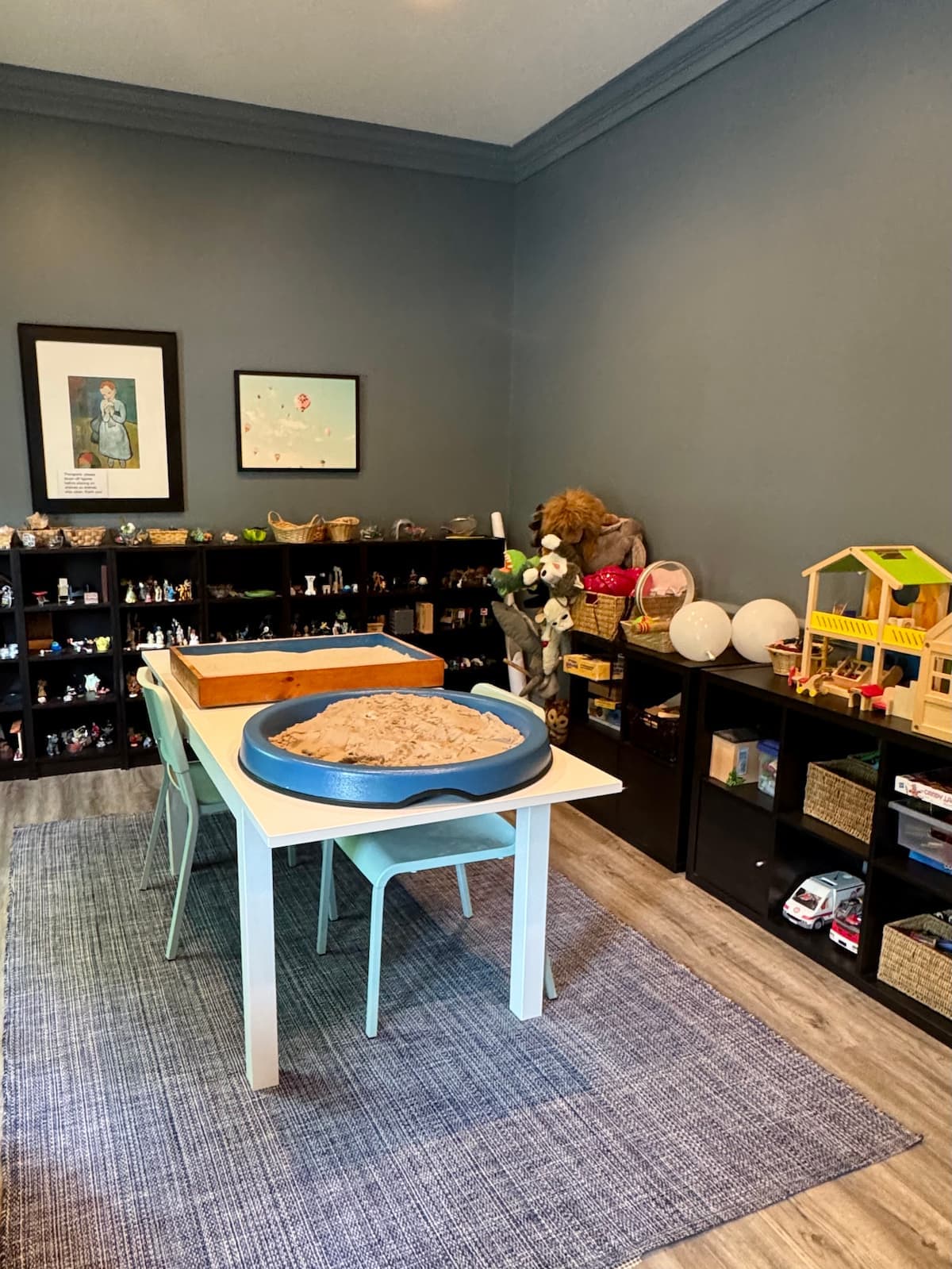
Play therapy allows young children to express and process distressing thoughts through their natural language—play. A play therapist trained in working with anxious and OCD-affected children uses toys, art materials, sand tray, and guided activities to help the child externalize their fears and practice flexibility in a safe, developmentally appropriate way. The therapeutic relationship itself—consistent, accepting, and child-centered—provides a foundation of safety while the child gradually learns that intrusive thoughts don't require ritualistic responses.
The dual-modality approach (play therapy for younger children who cannot yet verbalize complex internal experiences, CBT with ERP for older children and teens who can engage in structured exposure work) allows treatment to match the child's developmental level rather than forcing a single approach across all ages.
What Should Parents Do If They Suspect OCD?
If your child's repetitive behaviors or worries are consuming significant time (more than an hour daily), causing genuine distress, interfering with school or friendships, or not responding to reassurance, it's time to seek professional evaluation. Don't wait to see if they'll "grow out of it"—early intervention leads to better outcomes.
Before the appointment, keep a simple log of what you're observing: what triggers distress, what rituals follow, how long they take, and how your child reacts if prevented from completing them. This information helps clinicians understand the full picture quickly.
Look for licensed mental health professionals (Licensed Clinical Social Workers, Licensed Professional Counselors, or Licensed Marriage and Family Therapists) with specific training in treating childhood anxiety and OCD. Ask about their experience with exposure and response prevention, their approach to working with children your child's age, and how they involve parents in the treatment process.
For younger children, verify that the therapist has training in play therapy. The credentials RPT (Registered Play Therapist) or RPT-S (Registered Play Therapist-Supervisor) indicate advanced specialized training through the Association for Play Therapy—the highest level of play therapy certification.
How Can Parents Support a Child with OCD?
Parents play a crucial role in their child's recovery, though it requires walking a careful line. The natural parental instinct is to accommodate OCD—allowing extra time for rituals, participating in compulsions, providing repeated reassurance—because you see your child's genuine distress. Unfortunately, accommodation reinforces the OCD cycle and prevents the child from learning that they can tolerate distress without rituals.
With your therapist's guidance, you'll learn to gradually reduce accommodation. This doesn't mean being harsh or dismissive of your child's distress. Rather, it means responding with empathy to the feeling ("I can see this is really hard for you right now") while not participating in compulsions ("and I know you can handle this without checking again").
Maintain predictable routines outside of the OCD symptoms—consistent mealtimes, bedtimes, and family activities provide stability when the child's internal experience feels chaotic. Celebrate small victories when your child resists a compulsion or tolerates uncertainty, and avoid shaming or punishing OCD behaviors (the child already feels distressed by them).
Take care of your own stress levels. Parenting a child with OCD is exhausting and can strain marriages and family dynamics. Many parents benefit from their own therapy or support groups to process the experience and learn coping strategies.
Finding OCD Treatment in Alpharetta, GA
If your child is showing signs of OCD—persistent intrusive thoughts, time-consuming rituals, intense distress when prevented from completing compulsions, or impairment in school or social functioning—effective treatment exists. Children benefit most when they receive appropriate, evidence-based care matched to their developmental level.
McConaghie Counseling offers child therapy and play therapy in Alpharetta, GA, with therapists trained in treating childhood anxiety and OCD. Tracy McConaghie, LCSW, RPT/S holds the highest level of play therapy certification and specializes in working with young children who need developmentally appropriate treatment. Andrew McConaghie, LCSW leads a practice committed to helping children and families navigate difficult challenges with practical, effective approaches. Contact us to learn how we can support your child.
References
This post synthesizes information from authoritative medical sources including Johns Hopkins Medicine, Children's Hospital of Philadelphia (CHOP), Yale Medicine, Cedars-Sinai, and the National Institute of Mental Health (NIMH) regarding childhood OCD symptoms, prevalence, and evidence-based treatment approaches.