Understanding Your Child's Window of Tolerance: Managing Big Emotions

The window of tolerance is the zone of emotional arousal in which a child can think clearly, stay connected to others, and handle age-appropriate challenges without becoming overwhelmed. Developed by psychiatrist Dr. Dan Siegel in 1999, this concept describes the regulated state where children's nervous systems are balanced. Inside this window, a child can learn, solve problems, regulate emotions, and respond to stress without shutting down or melting down. Outside the window, children move into two distinct zones: hyperarousal (the red zone of intense emotions like anger, panic, or anxiety) or hypoarousal (the blue zone of shutdown, withdrawal, or numbness).
Understanding the window of tolerance helps parents recognize when their child has moved outside their capacity to self-regulate and needs adult support to return to calm. Children have narrower windows than adults, meaning they reach overwhelm faster and need more help getting back to baseline. When parents respond with co-regulation rather than punishment during these moments, children gradually develop wider windows and stronger self-regulation skills.
What Does the Window of Tolerance Look Like in Children?
Inside the window of tolerance, children appear calm, engaged, and able to respond flexibly. A child within their window can focus on homework when it's challenging, recover from disappointment when plans change, listen to instructions, play cooperatively, and express emotions without becoming overwhelmed. They might be excited, focused, or mildly frustrated, but the intensity stays manageable.
Outside the window, children enter dysregulated states. In hyperarousal (above the window), the nervous system activates the survival response. Children might appear aggressive, explosive, hyperactive, or frantic. Their bodies flood with stress hormones, heart rate increases, breathing quickens, and rational thinking goes offline. A child in hyperarousal might yell, hit, throw objects, or argue intensely over small things. They genuinely cannot access calming strategies or problem-solving skills.
In hypoarousal (below the window), the nervous system shuts down to protect against overwhelm. Children appear withdrawn, frozen, numb, or checked out. They might stare blankly, give one-word answers, or seem unable to engage even when you're speaking directly to them. This is not defiance. The child's system has moved into protective shutdown because the emotional demand exceeded their capacity.
Parents often misread these states as behavioral choices when they are actually nervous system responses the child cannot control in the moment. A child screaming during a meltdown is not making a rational choice. They are outside their window, and their brain's alarm system has taken over.
Why Are Children's Windows So Much Narrower?
Children's windows of tolerance are smaller than adults' windows for three interconnected reasons: brain development, limited experience, and skill gaps.
The prefrontal cortex, the brain region responsible for emotion regulation, impulse control, and rational decision making, does not fully mature until the mid-twenties. Young children lack the neurological hardware to regulate intense emotions independently. When stress hormones flood their system, they cannot think their way back to calm the way adults sometimes can. The developing brain simply lacks the circuitry for sophisticated self-soothing.
Children also have less life experience managing difficult emotions. Adults have weathered disappointments, navigated conflicts, and survived uncomfortable feelings hundreds of times. Children are encountering many situations for the first time and have not yet learned that the intensity will pass, that they can survive the discomfort, or what strategies might help. The novelty itself narrows the window.
Finally, children have not yet built the skills that expand tolerance: deep breathing, positive self-talk, perspective taking, distraction techniques, or seeking support appropriately. These skills develop gradually through thousands of interactions with caregivers who model them, name them, and practice them alongside the child.
Research demonstrates that maternal emotion regulation directly influences children's developing capacity. A recent longitudinal study found a bidirectional relationship between maternal emotion regulation difficulties and child socio-emotional problems throughout toddlerhood, with the connection appearing strongest when children were ages one and three (Verhagen et al., 2025). Notably, early child socio-emotional problems also predicted increased maternal emotion regulation difficulties at later time points, suggesting the relationship runs in both directions.
How Does Co-Regulation Help Children Expand Their Window?
Co-regulation refers to warm, receptive, and supportive interactions between caregiver and child that provide guidance and modulation of the child's emotions, behaviors, and thoughts. When a child moves outside their window of tolerance, they cannot regulate alone. They need an adult's calm nervous system to help bring their own system back into the regulated zone.
Co-regulation works through several mechanisms. First, your physical presence and calm demeanor send safety signals to your child's nervous system. When you stay regulated while your child is dysregulated, your body communicates "we are safe" through tone of voice, facial expressions, and body language. This activates the child's social engagement system and begins to calm their alarm response.
Second, co-regulation helps children name what they are experiencing. A child in hyperarousal might feel their heart racing and muscles tensing but not understand what is happening. When you say, "I can see your body is really worked up right now. Let's take some slow breaths together," you teach them to notice their own state and connect it with a coping strategy. Over time, this awareness becomes the foundation of self-regulation.
Third, co-regulation provides the external structure a dysregulated brain cannot create. You might lower your voice, dim the lights, reduce demands, or move to a quieter space. These environmental changes support the child's nervous system in downshifting back into the window. You are not trying to teach or reason with them in this moment. You are creating conditions for their physiology to settle.
The research on emotion coaching demonstrates this clearly. Programs that teach parents emotion coaching skills lead to measurably less emotionally dismissive parenting practices, more parental involvement, and better child outcomes including higher emotion competence and stronger regulation. Parents who can recognize emotional moments as opportunities for connection and teaching, rather than problems to fix or suppress, help children develop the internal resources to manage feelings independently.
What Widens a Child's Window Over Time?
Children's windows expand through repeated experiences of moving outside the window and being helped back in by a trusted adult. Each successful co-regulation teaches the child's nervous system it can return to calm after upset, building confidence in their own capacity to handle difficult emotions.
Secure attachment relationships form the foundation. Children who experience consistent, responsive caregiving develop trust that adults will help when overwhelmed. This trust itself widens the window because the nervous system does not interpret every challenge as a threat.
Skill building matters. As children gain practice with breathing exercises, naming emotions, and simple coping strategies, their repertoire for managing arousal grows. A child who knows three ways to calm down when frustrated has a wider window than one who knows none.
Reducing chronic stress protects and expands the window. Children living with ongoing adversity, unpredictable environments, or family conflict operate in a constant state of heightened alert, leaving less buffer before they tip into dysregulation. Addressing sources of chronic stress through therapy or family support allows the nervous system to settle and the window to widen.
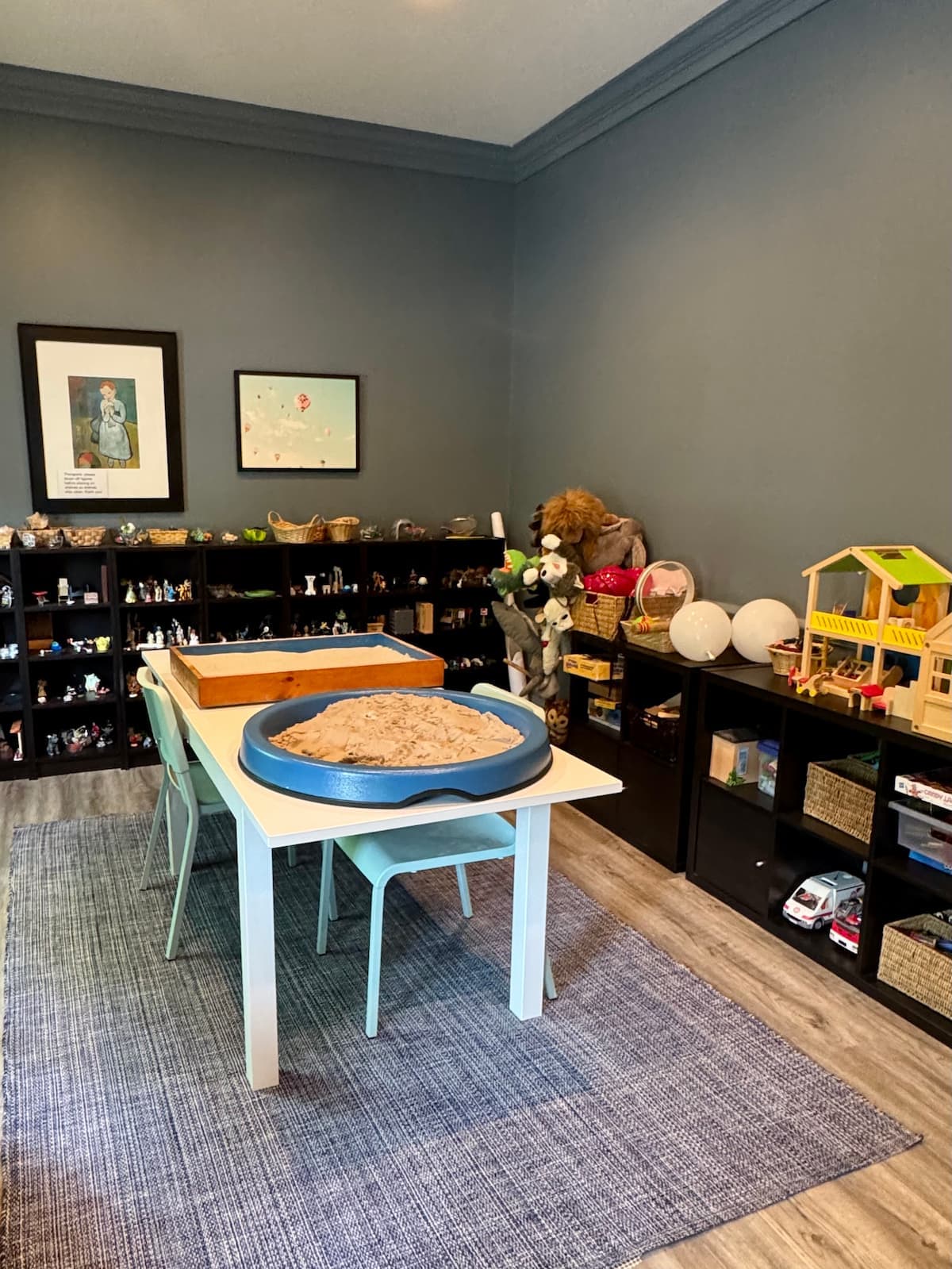
Play therapy offers a particularly effective avenue for young children who cannot yet verbalize complex feelings. Through play, children can process overwhelming experiences and practice regulation. For older children and teens, therapy helps them understand their own window, recognize early signs of moving outside it, and develop personalized strategies for staying regulated. Family therapy can address patterns that keep everyone's windows narrow.
What Should Parents Do When Their Child Is Outside the Window?
The first priority when your child is dysregulated is helping their nervous system return to the window of tolerance. Teaching, correcting, or problem solving can only happen once they are regulated again.
Stay calm yourself. Your own regulation is the most powerful tool you have. If you become dysregulated, you lose the ability to co-regulate them. Take a breath, remind yourself that this is a nervous system response, and consciously lower your own arousal.
Move closer, not farther away. Children in distress need connection. Offer your calming presence. Sit nearby if they do not want to be touched. Use a soft voice. Wait.
Validate the feeling without necessarily agreeing with the behavior. "You are really angry right now. I can see that" acknowledges their experience without endorsing hitting or yelling. Validation helps the child feel seen rather than wrong for feeling what they feel.
Offer simple support matched to their state. A child in hyperarousal might need help releasing tension through movement or going outside. A child in hypoarousal might need gentle engagement or time without pressure to talk. Learn what helps your child settle.
Wait until they are back in the window to address the behavior. The learning brain is offline when the alarm system is activated. Once calm returns, you can problem solve, discuss better choices, or implement consequences if appropriate.
How Can Parents Recognize When Their Child's Window Is Too Narrow?
Some children have windows so narrow that they spend much of their day outside the regulated zone, creating significant impairment in daily functioning.
Watch for patterns of frequent and intense dysregulation that occur multiple times daily, last longer than expected for the child's age, or are triggered by minor stressors other children handle easily. Notice if your child cannot recover from disappointment within a reasonable timeframe or reacts to small frustrations with the same intensity as major upsets.
Pay attention to whether your co-regulation efforts help. If your calm presence and support consistently fail to help your child return to baseline, or if episodes are becoming more frequent or severe, the window may be narrowing. This can signal underlying anxiety, trauma, or neurodevelopmental differences that need assessment.
If the narrow window prevents your child from participating in school, maintaining friendships, or engaging in family activities, intervention is needed. A window that narrow is not something a child will simply outgrow without support.
Finding Support for Your Child
If your child's window of tolerance is so narrow that daily life feels like navigating constant meltdowns or shutdowns, effective help exists. Play therapy provides young children a developmentally appropriate way to process overwhelming experiences and build regulation skills through their natural language of play. For older children and adolescents, individual counseling offers tools and strategies tailored to their developmental level. Family therapy can shift patterns that keep everyone's nervous systems on high alert.
Andrew McConaghie, LCSW and Tracy McConaghie, LCSW, RPT/S work with children and families navigating big emotions and narrow windows of tolerance. McConaghie Counseling offers in-person therapy in Alpharetta, GA and telehealth across Georgia. You can reach the practice at 770-645-8933 or through the contact page.
References
Verhagen, C., Duijndam, S., Kupper, N., Lodder, P., & Boekhorst, M. (2025). A cross-lagged panel model examining the longitudinal associations between maternal emotion regulation difficulties, parenting stress, and child socio-emotional problems in toddlerhood. Infant Mental Health Journal, 47(1), e70051. https://pmc.ncbi.nlm.nih.gov/articles/PMC12719906/
Siegel, D. J. (1999). The Developing Mind: How Relationships and the Brain Interact to Shape Who We Are. New York: Guilford Press.